


Syllabus: GS3/Economy; Environment
Context
- As per the World Economic Forum, India is positioning itself as a global electro-tech manufacturing hub by leveraging low-cost solar energy and battery technology bypassing the fossil fuel-heavy growth model followed by Western economies and China.
Major Highlights
- India’s push for energy sovereignty could serve as a fast-track model for emerging economies.
- In India solar energy accounts for about 9% of electricity, coal use per capita is far lower than China’s at a similar stage.
- Electric Vehicles: Passenger electric vehicles nearing 5% of total sales, while electric three-wheelers account for nearly 60% of the market, making India a global leader in the segment.
- India has reached about 1,500 kWh per capita electricity consumption, solar-plus-storage now costs roughly half as much as new coal.
- India’s electronics sector has grown six-fold to 130 billion dollars, supporting expansion into solar panels, batteries and EVs.
India’s Electronic Sector
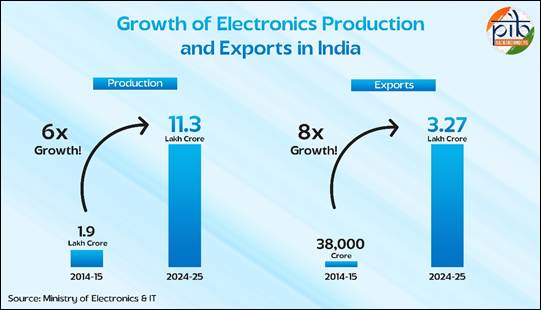
- India is the second largest mobile phone producer in the world.
- India has achieved near self-reliance in mobile production- from importing 78% of its requirements in 2014–15 to manufacturing almost all devices domestically today.
- Top 5 export destinations for Indian electronic goods in FY 2024–25 are the United States, United Arab Emirates, the Netherlands, the United Kingdom, and Italy.
- Electronics manufacturing created 25 lakh jobs in the last 10 years.
- India’s semiconductor ecosystem has gained significant momentum, with five landmark projects receiving approval with a total combined investment nearing Rs 1.52 lakh crores.
- Future Projections: It indicates that India’s electronics production will reach USD 300 billion by 2026.
Clean Energy in India
- As of 2025, the country’s total installed electricity capacity has crossed 500 GW, reaching 500.89 GW.
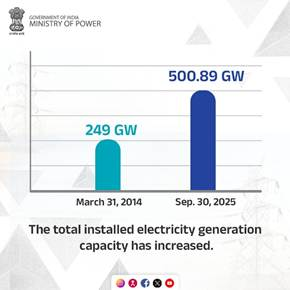
- Non-fossil fuel sources (renewable energy, hydro, and nuclear): 256.09 GW – over 51 % of the total.
- Fossil-fuel-based sources: 244.80 GW, about 49 % of the total, making coal a source of up to almost half the energy needs. Also, coal contributes about 74% of total electricity production in India.
- Within renewables:
- Solar power: 127.33 GW.
- Wind power: 53.12 GW.
- During FY 2025–26 India added 28 GW of non-fossil capacity and 5.1 GW of fossil-fuel capacity.
Government Initiatives
- Make in India: Launched in 2014, aimed at boosting India’s manufacturing sector and economic growth.
- Transform India into a global hub for design and manufacturing.
- Phased Manufacturing Programme (PMP): Launched in 2017, aimed to promote domestic value addition in mobile phones and their parts.
- Increased investment and set up significant manufacturing capacities in India.
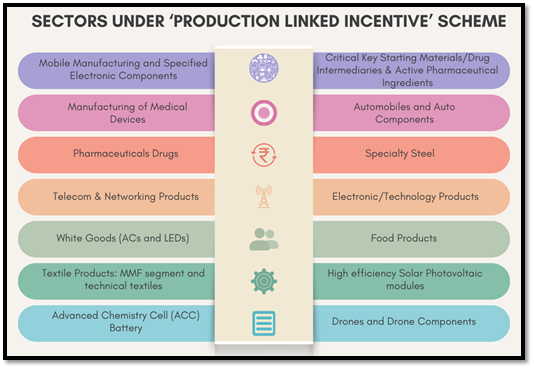
- Production Linked Incentive (PLI) Scheme: Introduced in 2020, aimed to boost domestic manufacturing in mobile phones, electronic components, and semiconductor packaging.
- Incentives: 3% to 6% on incremental sales (over base year) for eligible companies.
- Duration: 5 years.
- Semicon India Program: Launched in 2021, it is structured to promote the domestic semiconductor industry through incentives and strategic partnerships.
- At Global Investors Summit 2025, it was announced that India’s first indigenous semiconductor chip will be ready for production by 2025.
- The Scheme for Promotion of Manufacturing of Electronic Components and Semiconductors (SPECS): The scheme will provide financial incentive of 25% on capital expenditure for the identified list of electronic goods that comprise downstream value chain of electronic products.
- Electronics Component Manufacturing Scheme: The Union Cabinet chaired by the PM approved the Electronics Component Manufacturing Scheme with a funding of Rs.22,919 crore to make India Atmanirbhar in the electronics supply chain.
- Tenure of six years with a one-year gestation period.
- Expected Outcomes:
- Attract an investment of Rs.59,350 crore.
- Result in production of Rs.4,56,500 crore.
- Generate 91,600 direct jobs and numerous indirect jobs.
- Emerging Technologies & Projects: Support for Battery Storage, hybrid systems, and RTC power.
- Promotion of offshore wind and floating solar projects.
- Focus on Hydrogen Mission for green hydrogen development.
- International Partnerships: ISA (International Solar Alliance) launched by India to promote global solar cooperation.
- Collaboration with countries & global funds for clean energy investment and technology.
Source: AIR
Previous article
Row Over FCRA Amendment Bill 2026
